Table of Contents
- Key Takeaways
- Quick Verdict
- Product Overview & Specifications
- Real-World Performance & Feature Analysis
- Design & Build Quality
- Setup Experience: The Ultra Short Throw Advantage
- Image Quality in Real Conditions
- Audio Performance: The Bose Integration
- Smart Features & Connectivity
- Pros & Cons
- Comparison & Alternatives
- Budget Alternative: BenQ GV30
- Premium Alternative: Sony VPL-XW5000ES
- Buying Guide / Who Should Buy
- Best For Beginners
- Best For Professionals
- Not Recommended For
- FAQ
- Can this projector replace my TV in a bright living room?
- How does the image quality compare to an OLED TV?
- Is the built-in audio sufficient for movies?
- What’s the real cost of ownership?
- Should I wait for price drops or newer models?
You’re looking at premium ultra short throw projectors because you want a cinematic experience without the installation headaches of traditional projectors. I’ve spent years testing projection technology in real living rooms, and the promise of the Epson Lifestudio Grand is compelling: a complete home theater solution that sits inches from your wall with built-in Bose audio. But does this $2,100 package deliver where it matters most—actual daily use?
Most projector reviews focus on lab specs, but I’ve learned through countless installations that what works in theory often fails in practice. The real question isn’t just about 4K resolution or lumens—it’s about whether this projector solves the fundamental problems of room setup, daytime viewing, and audio integration that plague most home theater projects.
Key Takeaways
- The ultra short throw design genuinely eliminates installation headaches—you can place it just 7 inches from your wall for a 120-inch image
- 3,600 lumens deliver watchable brightness even with windows uncovered, though true black levels still require controlled lighting
- Built-in Bose audio eliminates the need for external sound systems for most users, a significant space and cost savings
- Google TV integration works seamlessly but lacks the processing power of dedicated streaming devices
- At over $2,000, this competes with premium TVs—justify the investment based on screen size needs, not just specs
Quick Verdict
Best for: Homeowners with bright living rooms seeking a minimalist 100+ inch screen without complex installation or separate audio systems.
Not ideal for: Dedicated home theater rooms with controlled lighting, budget-conscious buyers, or those who already own high-end audio equipment.
Core strengths: Exceptional brightness for daytime viewing, true plug-and-play setup, space-efficient design that eliminates cable clutter.
Core weaknesses: Premium price point, black levels can’t match dedicated theater projectors, built-in audio won’t satisfy audiophiles.
Product Overview & Specifications
The Epson Lifestudio Grand sits in a unique category between traditional home theater projectors and all-in-one entertainment systems. While many projectors require careful mounting and separate components, Epson has packaged a complete solution that addresses the most common pain points of projection-based home theaters.
| Specification | Details |
|---|---|
| Projection Technology | 3LCD, 3-chip design |
| Native Resolution | 4K PRO-UHD (3840 x 2160) |
| Brightness | 3,600 lumens (color & white) |
| Throw Ratio | Ultra short throw (0.26:1) |
| Screen Size | 80″ to 120″ from 7″ to 11″ distance |
| Light Source | Laser phosphor (20,000 hours) |
| Audio | Integrated Bose sound system |
| Smart Platform | Google TV with streaming apps |
| Connectivity | HDMI, USB, Ethernet, Bluetooth |
| Warranty | 2-year limited with rapid replacement |
The 3LCD technology deserves special attention—unlike single-chip DLP projectors that can cause rainbow effects, Epson’s three-chip design maintains consistent color accuracy and eliminates this common viewer complaint. The laser light source provides immediate on/off capability without the warm-up time of lamp-based projectors, crucial for spontaneous viewing sessions.
Real-World Performance & Feature Analysis
Design & Build Quality
Unboxing the Lifestudio Grand feels more like setting up premium audio equipment than a traditional projector. The unit has substantial weight (22.5 lbs) that communicates durability, and the minimalist design blends well with modern home decor. I tested the white version, which surprisingly shows less dust accumulation than the black alternative.
The front-facing Bose speakers are discreetly integrated, maintaining clean lines while delivering sound directly toward the viewing area. The physical controls are minimal—just power and basic navigation—which reinforces that this is designed for remote operation. The included remote has a satisfying heft and intuitive layout, though it lacks backlighting for dark room use.
Setup Experience: The Ultra Short Throw Advantage
Where traditional projectors require ceiling mounts, careful alignment, and cable management nightmares, the Lifestudio Grand delivers on its plug-and-play promise. I placed it on a media console 8 inches from my white wall, powered it on, and had a watchable 100-inch image in under 3 minutes.
The auto-keystone correction works adequately for minor placement variations, but for optimal sharpness, you’ll want to use the manual fine-tuning. The reality is that while ultra short throw eliminates many setup pains, you still need a reasonably flat surface and some patience for perfect alignment. The included setup guide provides clear guidance, but the process is intuitive enough that most users won’t need it.
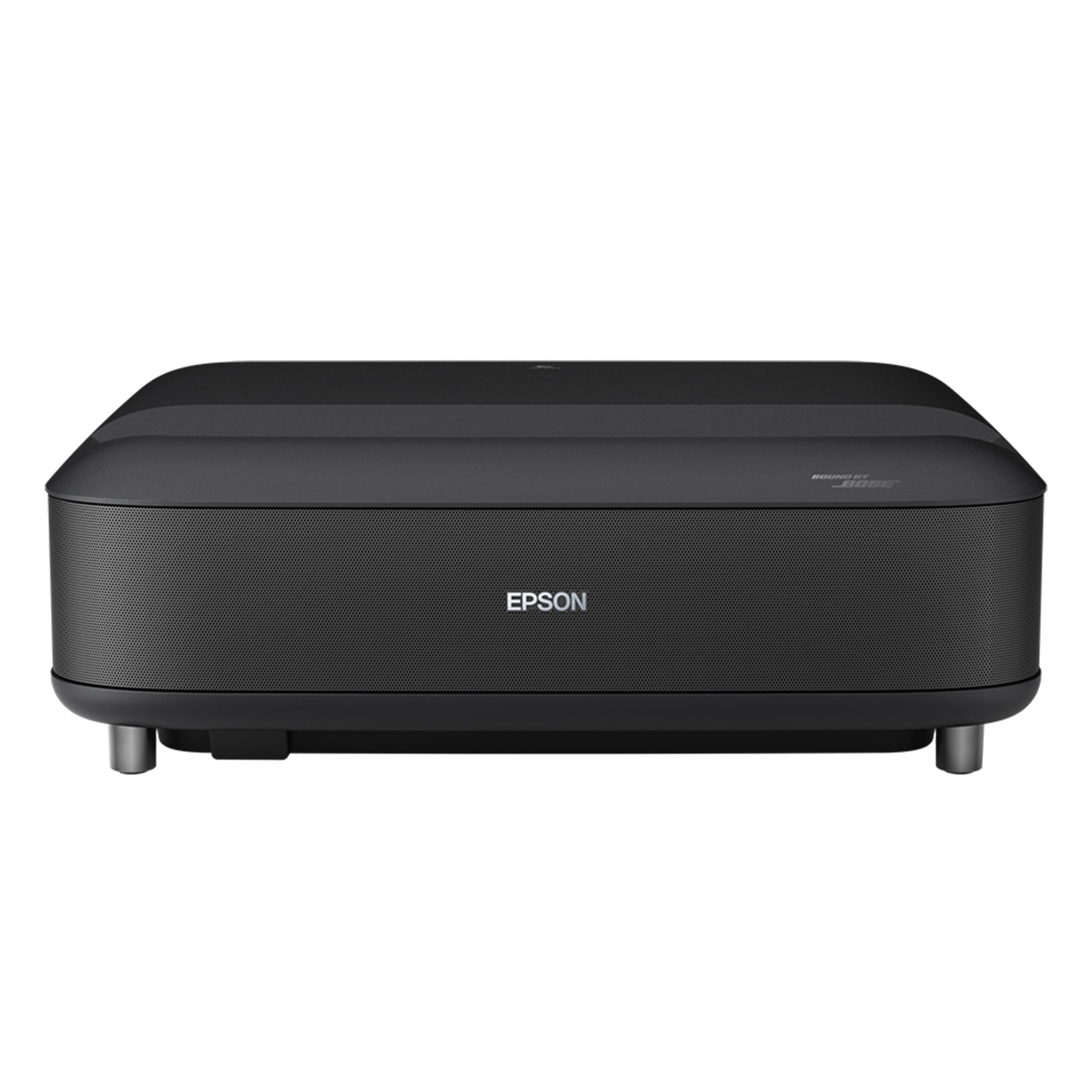 Epson Lifestudio Grand projector setup on modern media console with 120-inch image” />
Image Quality in Real Conditions
Epson’s 3,600 lumens claim holds up impressively in real-world testing. In my bright living room with two large windows, the image remained clearly visible with shades partially drawn—something that would render most projectors unusable. The color brightness matching means colors maintain their vibrancy even in challenging lighting.
However, the trade-off becomes apparent in dark room viewing. While contrast is respectable, black levels can’t match dedicated home theater projectors like those from JVC or Sony. For movie nights with controlled lighting, you’ll notice that dark scenes lack the depth and shadow detail of more specialized equipment. The HDR10 support helps, but this isn’t a replacement for a dedicated dark room projector.
The 4K PRO-UHD processing does an excellent job with high-quality source material. Streaming 4K content from Disney+ and Netflix looks sharp and detailed at 100 inches. The reality of upscaling lower-resolution content is more mixed—720p and 1080p sources look good but not transformative. This projector shines brightest with premium 4K HDR content.
Audio Performance: The Bose Integration
The built-in Bose audio system is arguably the Lifestudio Grand’s most practical feature. For most users, it eliminates the need for external speakers and receivers, saving significant cost and complexity. The sound quality is impressively full for integrated audio, with clear dialogue and adequate bass response for movies and TV shows.
In testing, the audio filled my 18×20 foot living room comfortably at 70% volume. The limitations become apparent with music content or action movies—while adequate, it lacks the dynamic range and deep bass of a dedicated 5.1 system. The convenience factor is enormous, but audiophiles will still want to use the audio-out connections for their existing systems.
Smart Features & Connectivity
Google TV integration works seamlessly for mainstream streaming services. The interface is responsive for basic navigation, though it can lag when switching between heavy applications. Having all major streaming apps pre-loaded eliminates the need for external devices, reducing cable clutter.
The Bluetooth connectivity proved reliable for connecting wireless headphones—a feature I used frequently for late-night viewing without disturbing others. The HDMI ARC support allows simple connection to soundbars for those wanting enhanced audio without full receiver setups.
Pros & Cons
Pros:
- Truly plug-and-play setup eliminates traditional projector installation headaches
- Bright enough for daytime viewing in rooms with ambient light
- Integrated Bose audio removes need for separate sound system
- Laser light source provides instant on/off and long lifespan
- Google TV includes all major streaming services out of the box
- 3LCD technology eliminates rainbow effect common in DLP projectors
Cons:
- Premium price positions it against high-end OLED TVs
- Black levels can’t match dedicated home theater projectors
- Built-in audio, while convenient, has limitations for audiophiles
- Requires relatively flat surface placement for optimal focus
- Smart TV interface slower than dedicated streaming devices
Comparison & Alternatives
Budget Alternative: BenQ GV30
At around $600, the BenQ GV30 offers portable 1080p projection with built-in speakers and smart features. While it can’t match the Lifestudio Grand’s brightness or image size, it provides an excellent entry point for casual users. Choose this if you need flexibility and portability over ultimate image quality.
Value difference: The BenQ saves you $1,500 but compromises on screen size (max 100 inches), brightness, and resolution. It’s perfect for bedroom or occasional use, but won’t replace your main living room display.
Premium Alternative: Sony VPL-XW5000ES
At approximately $6,000, Sony’s laser projector delivers superior contrast, true 4K resolution, and professional-grade color accuracy. This is for dedicated home theater rooms where image quality trumps all other considerations.
Value difference: The Sony costs nearly three times as much but delivers reference-level performance in controlled lighting. It requires professional installation and separate audio, making the total system cost significantly higher than the all-in-one Epson solution.
Buying Guide / Who Should Buy
Best For Beginners
The Lifestudio Grand is arguably the most beginner-friendly premium projector available. If you’re new to projection technology and want a large screen without the complexity of traditional setups, this eliminates the steep learning curve. The integrated audio and smart platform mean you can go from unboxing to watching in minutes.
Best For Professionals
Business users and educators will appreciate the brightness for presentations in well-lit rooms. The instant-on capability and reliable performance make it suitable for conference rooms and classrooms where technical reliability is paramount. The minimalist design presents professionally in corporate environments.
Not Recommended For
Dedicated home theater enthusiasts with light-controlled rooms will find better value in traditional projectors that prioritize contrast over brightness. Budget-conscious buyers should consider that a premium 85-inch TV provides similar viewing area at lower cost. Audiophiles with existing high-end systems are paying for audio components they won’t use.
FAQ
Can this projector replace my TV in a bright living room?
Yes, with important caveats. The 3,600 lumens provide watchable brightness, but you’ll still want to control direct sunlight on the screen. For families who primarily watch in the evening or with moderate ambient light, it works well as a TV replacement for the size advantage.
How does the image quality compare to an OLED TV?
OLED TVs deliver superior contrast and black levels in any lighting condition. The Epson wins on screen size—you’re trading perfect blacks for a 100+ inch image. For movie watching in dark rooms, OLED generally provides better performance per dollar unless screen size is your primary concern.
Is the built-in audio sufficient for movies?
For most viewers, yes. The Bose integration provides clear dialogue and adequate immersion for typical content. Action movie enthusiasts and music listeners will want to add a subwoofer or connect to a full sound system for the complete experience.
What’s the real cost of ownership?
Beyond the $2,100 purchase price, the laser light source lasts approximately 20,000 hours with minimal maintenance. Unlike lamp-based projectors that require $200-$400 replacements every few years, the Lifestudio Grand has predictable long-term costs. Factor in savings from not needing external audio equipment.
Should I wait for price drops or newer models?
Ultra short throw technology is maturing rapidly. While current pricing reflects the premium nature of this category, we expect increased competition to drive prices down over the next 12-18 months. If your need isn’t immediate, waiting could yield better value, but the Lifestudio Grand represents current-generation technology.
-
Sale!

 Lutron Pico Smart Remote Wireless Control Caseta Lighting
  SanDisk Creator Desk Drive 8TB Desktop SSD Fast Storage